
A TransLōc perspective on transit agility
A sudden road closure, a special event, or a construction detour can force a transit agency to change a route with almost no notice. This piece looks at what happens when the people who plan the service — not an outside help desk — are the ones who can make that change, and why more agencies are moving in that direction.
Key takeaways:
- Fixed-route service runs into constant, small disruptions: detours, construction, weather, special events, seasonal demand shifts.
- For years, even a minor route change has often meant opening a support ticket and waiting for someone else to make the edit.
- Agencies are increasingly able to test and publish their own route, stop, and schedule changes directly, without touching a live system until they’re ready.
- This shifts the agency’s role from requester to operator of its own transit data.
- Vehicle and hardware issues still typically require vendor support — this is about the configuration layer: routes, stops, schedules, and rider-facing details
It’s 3:40 on a Friday afternoon. The city just posted a notice: a two-block stretch of downtown will close Monday morning for utility work, and it happens to run straight through the middle of your busiest route.
A few years ago, this is where the afternoon would start to unravel. Somebody drafts an email to the transit software provider’s support desk. Somebody else pulls up the printed route map to sketch a workaround by hand. The fix might not be live until Wednesday, which means two days of drivers improvising, riders guessing, and a dispatcher fielding phone calls about a detour nobody explained.
Now picture the same Friday afternoon, except the person who knows the route best — the planner sitting at the agency, not a help desk three states away — opens the system, builds the new path, tests it, and has it ready for Monday’s first trip. No ticket. No wait. No guessing.
That shift, from requesting a change to making one, is what this piece is about.
For agencies running TransLōc Fixed Route, that shift is increasingly part of the same platform they already use every day — not a separate system to learn, but another layer of the same dashboard, now under the agency’s own control.
Change Is the Constant, Not the Exception
Ask anyone who plans fixed-route service, and they’ll tell you the schedule on paper rarely survives contact with a real week. A stadium adds a Saturday game. A storm closes an intersection for a month. A university shifts its academic calendar. A new development changes where people need to get on and off the bus.
None of these are edge cases. They’re the job.
It helps to think about route change in three buckets:
Planned change — seasonal schedule updates, new academic terms, service expansions the agency has known about for months.
Semi-planned change — a marathon, a festival, a home game, where the date is known but the specific routing adjustments often get finalized close to the event.
Unplanned change — a water main break, a downed tree, a closure announced with a weekend’s notice, where the agency has hours, not weeks, to respond.
Most transit software was built to handle the first bucket reasonably well. It’s the second and third — the ones that test an agency’s agility — where waiting on someone else to make the edit has historically cost the most time.
(Source: TransLōc)
What Changes When the Agency Holds the Pen
The instinct to keep route and schedule editing locked behind a support desk made sense for a long time. Route data is public facing. Get a stop wrong, or leave a line disconnected, and riders see it immediately in a wrong arrival time or a bus that never shows. Caution was reasonable.
But caution and speed aren’t opposites, and that’s the more interesting part of this shift. The agencies moving toward in-house route management aren’t skipping the safety net — they’re testing changes in a sandbox copy of their system first, confirming stops, paths, and timing line up, and only then pushing the update live. The support ticket isn’t replaced by guesswork. It’s replaced by a rehearsal the agency controls the pace of.
Back to that Friday afternoon detour. Here’s roughly how it plays out when the agency owns the process:
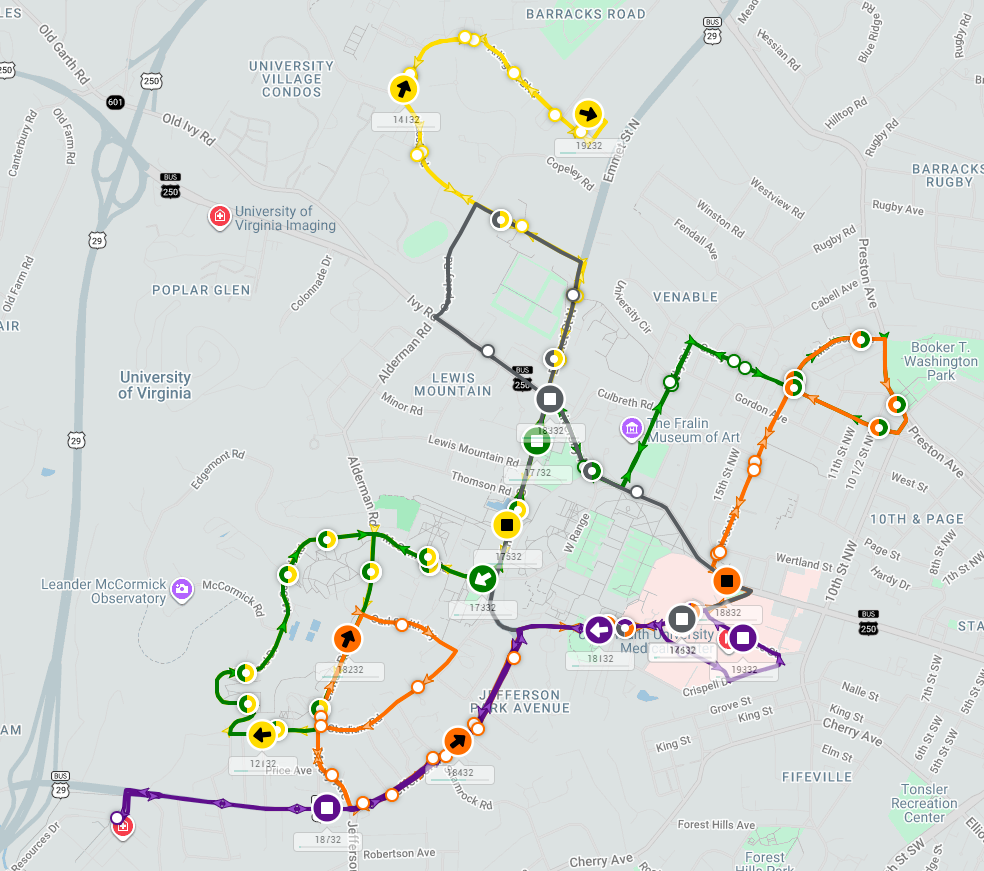
The planner starts by copying the active route configuration into a new draft — something they might name plainly, like “Downtown Reroute” or “Fall Construction,” so anyone on the team can find it later. Inside that draft, they adjust the affected route: new stop placement where needed, an updated path around the closed block, the connecting lines redrawn so arrival estimates keep working. They preview it, checking that the new stops line up correctly and the route reads clearly for a driver seeing it for the first time. Then they set it to take effect Monday morning and move on with their Friday.
Vehicle and hardware issues still tend to need the original support relationship those are tied to physical equipment, not configuration. But the day-to-day reshaping of routes, stops, and schedules is no longer a request. It’s a task.
(Source: TransLōc)
The Bigger Shift: Owning the Data, Owning the Response
Step back from any single detour and a broader pattern shows up. Agencies that can adjust their own service are, by definition, less dependent on someone else’s response time. That has a few knock-on effects worth naming plainly:
Riders get updated information faster, because the person who knows about the closure is the same person who can fix the route. Internal teams spend less time writing tickets and more time planning service. And because these systems generally export route and schedule data in open, standardized formats, the changes an agency makes for its own trip planner also flow through to the regional apps and trip-planning tools riders already use — so a fix made in-house doesn’t just fix one screen, it keeps the whole information chain consistent.
None of this makes route planning easy. Drawing a line that correctly reconnects at every stop, or making sure a shared stop update doesn’t quietly break a different route that uses the same address, still takes real attention. Agencies adopting this model report that the learning curve is real, particularly around testing changes properly before they go live. But the direction is clear enough: more of the transit industry is moving toward giving agencies direct control over their own configuration data, rather than routing every small change through a third party.
This is the shift TransLōc has been building toward with agencies across the country — not by removing support, but by putting more of the everyday decisions back where they belong: with the people planning the service.
(Source: TransLōc)
What This Means for Your Agency
If your team has ever sat on hold — figuratively or literally — waiting for a route change during a week that couldn’t wait, it’s worth asking your TransLōc account team what’s already possible inside the platform you’re using today. Many agencies are discovering that more of this control already exists, or is coming soon, than they realized.
The Friday-afternoon detour isn’t going away. Whether it costs your agency an afternoon or a weekend increasingly comes down to who’s holding the pen.
Frequently Asked Questions (FAQ): In-House Route Management
What is in-house route management, in plain terms?
It’s the ability for a transit agency’s own staff to create, test, and publish changes to routes, stops, and schedules directly, rather than submitting those changes to an outside support team and waiting for them to be made.
This typically covers the configuration side of a fixed-route system: route paths, stop locations and details, schedules and trips, and related rider-facing settings. Vehicle and hardware changes usually remain a separate process handled with vendor support, since those are tied to physical equipment.
Why does this matter more now than it use to?
Rider expectations for accurate, real-time information have risen, and the pace of disruptions an agency must respond to — construction, special events, severe weather — hasn’t slowed down. Any gap between “we need to change this route” and “riders can see the change” shows up directly as confusion at the curb.
Does giving agencies more control introduce more risk of mistakes?
Any hands-on-the-wheel model needs guardrails. Systems built for this typically let an agency build and test a change in a separate draft or sandbox copy first, so nothing goes live until it’s confirmed to work correctly. The safeguard shifts from “someone else checks it” to “you check it before you publish it,” which most agencies find is a fair trade for the speed they gain.
What kinds of changes are we talking about?
The range is broad: seasonal schedule updates, new stops for a growing corridor, a detour around construction, adjusted routing for a stadium event, or fine-tuning where and when a rider sees an arrival estimate. Some changes are planned months out; others need to happen within hours.
Does this replace the relationship with a transit technology provider?
Not entirely. Agencies still typically rely on their provider for hardware, vehicle equipment, platform updates, and support for anything outside day-to-day configuration. What changes is that the routine, recurring work of shaping the service — the part agencies know best because they live it every day — moves in-house.
How does this affect the data that trip-planning apps and regional partners see?
Because route and schedule updates are generally exported in standard, open transit data formats, a change made directly by the agency typically flows through to the third-party apps riders already use, keeping trip-planning information consistent across platforms rather than updated in only one place.
Curious what your current platform already lets your team do without a ticket?
It’s worth a quick conversation with your TransLōc account representative — you may have more control at your fingertips than you think.