
Quick summary:
On a demand-response network, not every booking becomes a trip. Research on paratransit and demand-response systems treats cancellation and no-show rates as a core productivity metric, not a rounding error, and one long-running paratransit study flagged a cancellation rate above 15 percent as high enough to warrant intervention. On a fixed number of vehicles, capacity lost this way doesn’t show up as an overload. It shows up as unpredictability for the riders who need the service.
What you’ll take away:
- Cancellation and no-show rates are a recognized productivity metric in demand-response and paratransit research, not a minor operational footnote
- One paratransit service analysis treats a cancellation rate above 15 percent as high enough to require action
- Capacity lost to repeated cancellations and no-shows is invisible in aggregate ridership numbers; it shows up as inconsistent wait times instead
- A configurable, automatically enforced limit policy is a long-standing paratransit practice, now applicable to OnDemand Microtransit through software rather than manual dispatcher intervention
- The right threshold depends on each agency’s own ridership pattern, not a fixed industry rule
OnDemand Microtransit is transit service that dynamically routes vehicles based on real-time rider requests, without a fixed path or schedule. That flexibility is the entire value proposition: a rider requests a trip when they actually need one, instead of waiting on a fixed schedule that may not match their day.
The same flexibility creates a quieter vulnerability. A booking is a claim on a finite resource, a vehicle, a seat, a slot in a route, before the trip has actually happened. When a rider cancels late or fails to show up, that claim doesn’t get returned to the pool in any useful way. The capacity was reserved, then wasted.
Capacity Loss That Doesn’t Look Like an Overload
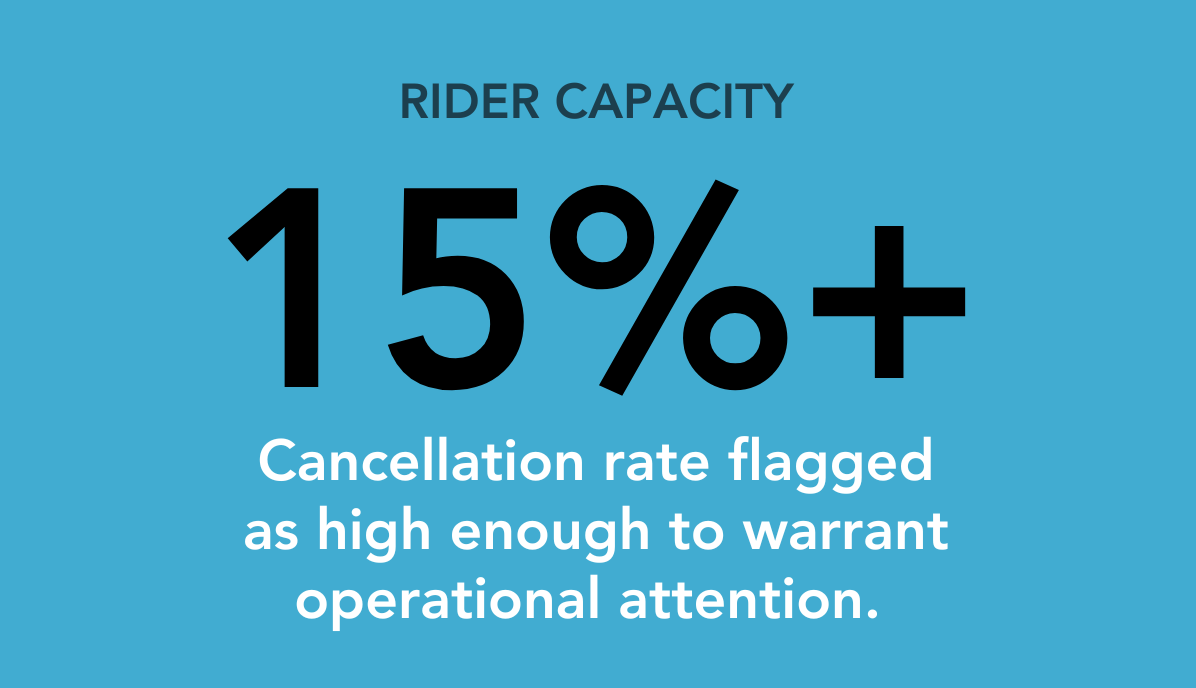
This isn’t a new problem specific to any one platform. The Texas A&M Transportation Institute’s research on demand-response transit treats no-shows as a direct threat to schedule efficiency and on-time performance, serious enough that a formal no-show policy, typically involving dispatcher notification and a penalty before a rider can book again, is standard practice across the paratransit field. A 2014 paratransit service analysis for the Pioneer Valley Transit Authority went further and put a number on it: a cancellation rate above 15 percent was flagged as high enough on its own to warrant operational attention.
None of this shows up as an obvious capacity crisis. A network can look adequately provisioned in aggregate, enough vehicles, enough scheduled capacity for the ridership on paper, while a meaningful share of that capacity quietly evaporates before it ever reaches a rider who would have used it. What a rider experiences instead is inconsistency: a fast pickup one day, an unexplained long wait the next, with no visible cause, because the cause isn’t a lack of vehicles. It’s vehicles committed to trips that were never going to happen.
Researchers have taken this seriously enough to try to predict it directly. A 2020 study in Transportation Research Record tested machine learning methods to forecast which paratransit reservations were likely to actually become trips, treating cancellation prediction as a lever for improving system productivity, not just a customer service issue to smooth over after the fact.
Rider Capacity
15%+
Cancellation rate flagged as high enough to warrant operational attention.
Not every booking becomes a trip.
Pioneer Valley Transit Authority
Paratransit Service Analysis, 2014
Rider Capacity
15%+
Cancellation rate flagged as high enough to warrant operational attention.
Not every booking becomes a trip.
Pioneer Valley Transit Authority
Paratransit Service Analysis, 2014
(Source: Nelson/Nygaard Consulting Associates, Paratransit Service Analysis Study, 2014)
A Framework for Diagnosing Where the Capacity Is Going
Before reaching for any specific fix, it’s worth asking three questions about a demand-response network’s own data:
Is the cancellation or no-show rate concentrated, or spread evenly? A small number of riders responsible for a disproportionate share of cancellations points to a rider-level policy. A rate spread evenly across the whole rider base points to a different problem, likely something about the booking process or trip windows themselves.
Does the rate cross a threshold worth acting on? Not every cancellation is a problem; riders’ plans change. The paratransit field’s own benchmark, cancellation rates climbing above roughly 15 percent, is a reasonable starting reference point, not a hard rule every agency should adopt uncritically.
Is the response manual or automatic? A no-show policy enforced by a dispatcher noticing a pattern and intervening by hand doesn’t scale, and it depends on someone catching the pattern in the first place. A policy enforced automatically, consistently, the moment a rider crosses a defined threshold, doesn’t have that gap.
Paratransit practiceA Known Problem,
A Newer Fix
No-show and cancellation policies have long been standard paratransit practice.
Automatic, platform-level enforcement is what’s changed.
Texas A&M Transportation Institute
Transportation Policy
Paratransit practiceA Known Problem,
A Newer Fix
No-show and cancellation policies have long been standard paratransit practice.
Automatic, platform-level enforcement is what’s changed.
A Newer Fix
Automatic, platform-level enforcement is what’s changed.
Texas A&M Transportation Institute Transportation Policy
(Source: Texas A&M Transportation Institute, Transportation Policy Research)
Turning the Diagnosis Into a Policy
The paratransit field has used manual versions of this approach for years, dispatcher notification, a penalty, a hold on future bookings. What’s changed is the ability to run that same logic automatically, at the platform level, without a person needing to notice the pattern first.
TransLoc recently introduced OnDemand User Limits, a feature that applies that logic directly inside the booking system. Agencies set their own thresholds, a daily ride limit per rider, a cancellation limit within a defined lookback window, a no-show limit with a defined cooldown, and the system enforces them automatically once they’re set. A rider who crosses a threshold sees a clear explanation in the app rather than a booking that simply fails. Because the feature requires riders to sign in through single sign-on, a restricted rider can’t route around the limit by creating a new account, closing the loophole that undermines manual versions of the same idea.
None of the specific thresholds are prescribed. What counts as a high cancellation rate on one campus may be entirely normal on another, and the right lookback window depends on how that agency’s ridership actually behaves. The policy question comes first. The configuration follows from the answer.
The Framework3 Diagnostic Questions
Is the rate concentrated, or spread evenly?
Does it cross a meaningful threshold?
Is the response manual, or automatic?
The Framework3 Diagnostic Questions
Is the rate concentrated, or spread evenly?
Does it cross a meaningful threshold?
Is the response manual, or automatic?
Does it cross a meaningful threshold?
Is the response manual, or automatic?
(Source: Internal framework, based on the cited research)
Frequently Asked Questions (FAQ): Managing Cancellations and No-Shows in OnDemand Microtransit
Why do cancellations and no-shows’ matter if overall ridership numbers look fine?
Because capacity lost to a canceled or no-show booking doesn’t show up as an aggregate shortfall. It shows up as inconsistent wait times for riders who book in good faith, since the vehicle capacity was reserved and then wasted rather than simply unused.
What cancellation rate should be considered a problem?
There’s no universal number, but a 2014 paratransit service analysis for the Pioneer Valley Transit Authority flagged a cancellation rate above roughly 15 percent as high enough to warrant operational attention. Each agency’s own ridership pattern should inform its own threshold.
What cancellation rate should be considered a problem?
There’s no universal number, but a 2014 paratransit service analysis for the Pioneer Valley Transit Authority flagged a cancellation rate above roughly 15 percent as high enough to warrant operational attention. Each agency’s own ridership pattern should inform its own threshold.
Is limiting rider bookings based on cancellations or no-shows a new idea?
No. Dispatcher-enforced no-show policies, often including a notification and a penalty before a rider can book again, have been standard practice in paratransit for years. What’s changed is the ability to enforce that same logic automatically at the platform level.
How does OnDemand User Limits enforce these rules automatically?
Agencies set their own thresholds for daily ride limits, cancellation limits within a defined lookback window, and no-show limits with a defined cooldown. Once set, the system enforces them without requiring manual intervention from dispatch or admin staff.
Why does the feature require single sign-on (SSO)?
SSO ties booking limits to a verified identity, preventing a restricted rider from bypassing a limit by creating a new account.
Does this affect Fixed Route service?
No. OnDemand User Limits is built for University OnDemand riders booking trips within their agency’s on-demand service.
Curious Where Your Own Network Is Losing Capacity?
Every agency’s cancellation and no-show pattern looks different, and the right threshold for one campus may not fit another. If unpredictable wait times are showing up on your OnDemand Microtransit network, it’s worth looking at where the capacity is actually going before assuming the fix is more vehicles.