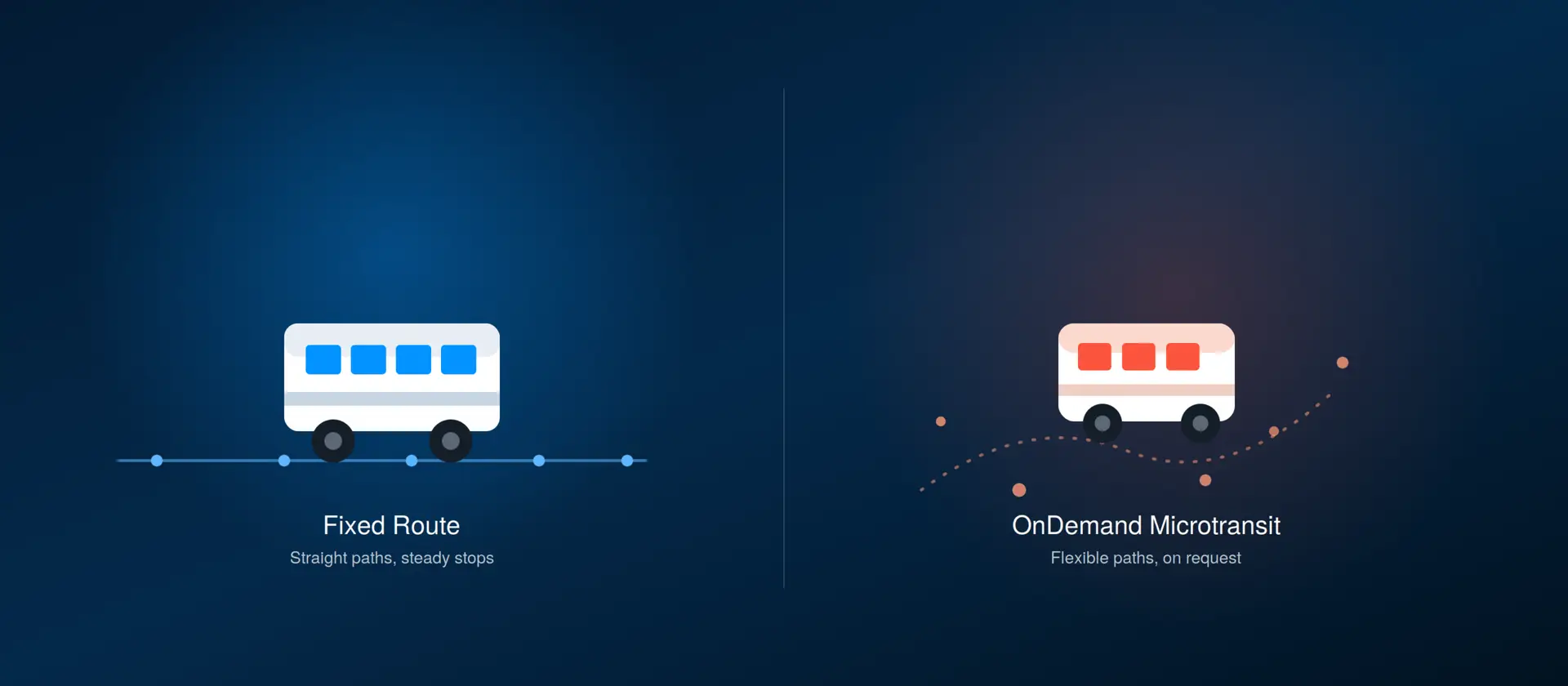
Quick summary: Fixed Route and OnDemand Microtransit are not competitors. They are tools that work well in different conditions, and the agencies that get the most value from either one are the agencies that diagnose their conditions before they choose. This piece walks through how to do that diagnosis.
What you’ll take away:
- Fixed Route and OnDemand Microtransit solve different problems. Neither one is a universal upgrade over the other.
- OnDemand Microtransit works best when it replaces a genuinely underperforming route or fills a real coverage gap, not when it is added as a general-purpose convenience.
- Density, trip patterns, span of service, budget tolerance, and existing route performance are the five inputs that should drive the decision.
- Real-world pilots show what happens when the fit is wrong: low boardings per service hour and subsidy costs that climb over time.
- Simulation and data modeling exist so agencies don’t have to guess. Use them before you commit, not after.
Table of Contents
Every few years, a new piece of transit technology shows up promising to solve problems that Fixed Route service can’t. OnDemand Microtransit had that moment, and in some ways it still does. The pitch is appealing: riders request a trip, a vehicle comes, no fixed schedule to miss. For agencies wrestling with low-ridership routes or coverage gaps in low-density areas, it sounds like the obvious next step.
But “obvious” and “correct” aren’t the same thing. OnDemand Microtransit has a real, well-documented track record of underperforming when it’s dropped into the wrong environment. That’s not a reason to avoid it. It’s a reason to be disciplined about when you use it.
Two Tools, Two Jobs
Fixed Route is transit service that runs a set path on a published schedule. OnDemand Microtransit is transit service that dynamically routes vehicles based on real-time rider requests, without a fixed path or schedule.
Fixed Route service is built for volume. It works because a lot of people are moving along the same corridors at roughly the same times. A bus running every fifteen minutes down a busy avenue can move hundreds of people an hour at a low cost per ride, because the vehicle is full, or close to it, most of the time. That efficiency depends on density: enough people, close enough together, headed in similar directions.
OnDemand Microtransit is built for something else. It exists for the trips that don’t cluster into a corridor. Think of a sprawling suburban zone with no clear travel pattern, a first-mile or last-mile connection to a rail station, or overnight service when ridership is too thin to justify a fixed loop. In those conditions, a vehicle that goes where the requests are can outperform a bus that runs a fixed path whether anyone’s there or not.
The mistake agencies make isn’t choosing the wrong mode in a vacuum. It’s assuming one mode is generally better and then looking for places to apply it, instead of starting with the travel pattern and asking which tool actually fits.
What Happens When the Fit Is Incorrect
OnDemand Microtransit applied outside its sweet spot produces a consistent, well-documented pattern: low productivity and rising cost per trip. This isn’t theoretical. The transportation research community has been tracking on-demand pilots for years, and the results repeat across cases.
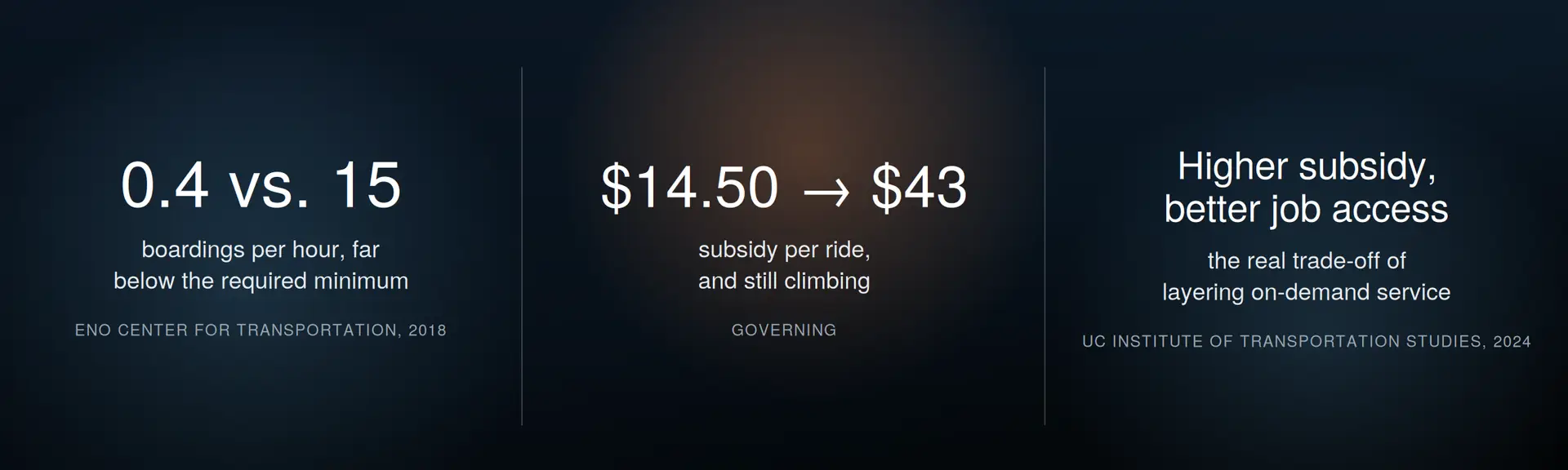
The Eno Center for Transportation’s 2018 review of microtransit pilots found that a Silicon Valley on-demand pilot generated just 0.4 boardings per revenue hour over its six-month run, against the 15 boardings per revenue hour the local agency required to keep a fixed bus route running. It’s the kind of number that should stop a planning team in its tracks: a pilot performing at roughly 3 percent of the productivity bar that would keep a comparable bus route alive.
The cost side tells a similar story. Governing’s reporting on a Los Angeles Metro on-demand pilot found the per-ride public subsidy was estimated at $14.50 in 2019, and has since been reported at around $43 per ride. Subsidy isn’t inherently a problem in transit. Almost all transit is subsidized. But a subsidy nearly tripling over several years, on a service meant to be a cost-effective complement to Fixed Route, is a signal that something about the deployment doesn’t match the demand it’s serving.
A 2024 University of California Institute of Transportation Studies analysis of California transit agencies found a related tradeoff worth sitting with: when on-demand service is layered onto an existing network, it tends to reduce Fixed Route ridership and requires higher subsidies overall, even as it improves job access for the riders it serves directly. That’s not an argument against OnDemand Microtransit. It’s an argument for being deliberate about who a new service is meant to help, and being honest about what it costs the rest of the network to get there. That’s an equity question as much as a budget question, and it belongs in the decision, not as an afterthought after the contract is signed.
None of this means OnDemand Microtransit doesn’t work. It means it works when the underlying travel pattern actually calls for it, and it underperforms, when it’s applied as a general-purpose upgrade to a network that would be better served by fixing or restructuring Fixed Route.
A Framework for Making the Call
Before choosing a service model, a planning team should be able to answer five questions with actual data, not intuition.
1. What does the density and land use look like? Dense, mixed-use corridors with steady two-way flow are Fixed Route territory. Low-density, dispersed, or single-purpose zones (industrial parks, spread-out residential subdivisions, campuses with sprawling edges) are where OnDemand Microtransit tends to earn its keep.
2. What do the actual trip patterns show? Pull the data. Are trips concentrated along a handful of corridors at predictable times, or scattered across origins and destinations with no clear shape? Fixed Route needs the former. OnDemand Microtransit tolerates, and is often built for, the latter.
3. What span of service is actually needed? Overnight and off-peak windows, where ridership is real but too thin to justify a full-size bus running empty, are a classic OnDemand Microtransit use case. Peak-period, high-volume windows are usually a Fixed Route job.
4. What’s the budget tolerance, and is it about to grow? A pilot that looks affordable at launch can get more expensive as ridership settles in, or as an agency scales it up. Model the cost per trip at multiple ridership levels before committing, not just at the pilot size.
5. Is this replacing a route that’s already underperforming, or adding a new layer on top? OnDemand Microtransit has the best track record when it takes the place of a Fixed Route with productivity that’s already below the threshold an agency would use to justify keeping it running. It has a weaker track record when it’s introduced as an added convenience layered onto an otherwise stable network.
Run an honest answer through all five, and the right model usually becomes clear. Sometimes the answer isn’t either mode alone. It’s a hybrid network where Fixed Route handles the corridors that can support it and OnDemand Microtransit handles the gaps that Fixed Route structurally can’t reach.
Don’t Guess. Model It.
Simulation and planning modeling exist to answer these five questions before a dollar is committed. The agencies that get burned by OnDemand Microtransit are rarely the ones that ran the numbers first. They’re the ones that launched based on enthusiasm, a vendor pitch, or pressure to be seen doing something new, and found out the productivity or cost problem after the service was already live and hard to unwind politically.
That’s the discipline worth building into the decision process: not “which mode is better,” but “which mode fits what our data says our riders actually need, in this specific place, at this specific time of day.” The agencies that ask it that way tend to end up with networks that work, and budgets that hold.
Frequently Asked Questions (FAQ): Fixed Route vs. OnDemand Microtransit
Is OnDemand Microtransit cheaper than Fixed Route bus service?
Not necessarily, and often not at all once ridership matures. Per-ride subsidy for on-demand service can start reasonable and rise significantly over time, particularly if the service was deployed in an area where trip patterns don’t naturally support demand-responsive routing.
When does OnDemand Microtransit make the most sense?
It tends to perform best in low-density areas, for first-mile and last-mile connections to Fixed Route or rail service, and during off-peak or overnight hours when ridership is real but too thin for a full Fixed Route.
When should an agency avoid launching OnDemand Microtransit?
When the goal is to serve a dense corridor with steady, predictable two-way travel, or when the service would be layered on top of an already-stable Fixed Route network rather than replacing an underperforming one.
Does adding OnDemand Microtransit take money away from Fixed Route riders?
It can, depending on how it’s funded. If an on-demand program draws budget away from high-frequency Fixed Routes, the riders most dependent on those routes, often those with fewer transportation alternatives, can be the ones who bear the cost. This is a funding and equity question agencies should evaluate directly rather than assume away.
Can a network run both Fixed Route and OnDemand Microtransit at the same time?
Yes, and for many agencies this hybrid approach is the strongest fit: Fixed Route covers corridors dense enough to support it, and OnDemand Microtransit covers the gaps, low-density zones, and off-peak windows that Fixed Route structurally can’t serve well.
What data should inform the decision before launch?
Density and land use patterns, actual trip origin and destination data, the span of service required, budget tolerance modeled across multiple ridership scenarios, and the productivity of any existing route the new service might replace.
Is there a way to test this before committing to a launch?
Simulation and planning modeling tools are built for exactly this. They let a team estimate ridership, cost per trip, and network impact using real data before a service goes live, rather than finding out after the fact.
Not Sure Which Model Fits Your Network? Let us guide you though this process.
Every network is different, and the right mix of Fixed Route and OnDemand Microtransit depends on the data specific to your service area. If you’re weighing this decision for your own agency or campus, TransLoc’s planning and simulation tools can help you model the tradeoffs before you commit a budget to either direction.